

Contents:
As businesses become more digitalised, the importance of enterprise resource planning (ERP) is being recognised more than ever. ERP systems allow for seamless integration, automation, and collaboration between different operational aspects within a business.
In this blog, we delve into the industries where ERP is used the most and why it's a vital tool. We also reveal the challenges ERP addresses and our future predictions for the technology.
The most frequent industry adopters of ERP systems are businesses where efficient operation planning and control are vital. These industries include manufacturing, logistics, engineering, healthcare, and construction, all of which typically handle vast amounts of information and data generated from their activities.
In these sectors, ERP streamlines processes, ensuring that information and data across the whole organisation are integrated, which subsequently supports operational efficiency and decision-making.
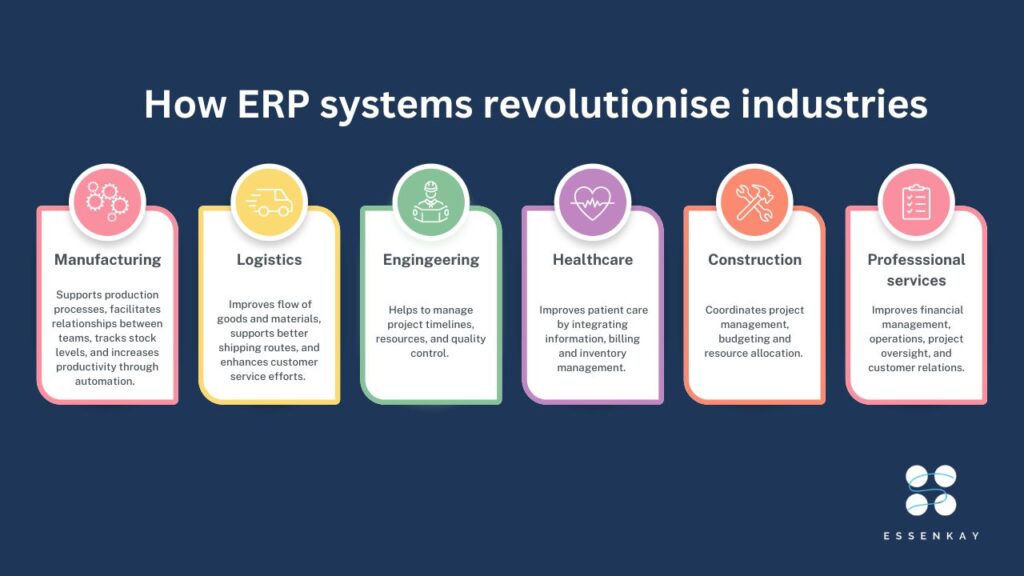
Manufacturing: This department focuses on supporting the production processes, facilitating better relationships between engineering teams and manufacturing, tracking stock levels, and increasing productivity through automation.
Logistics: Improves flow of goods and materials, supports better shipping routes, and enhances customer service efforts.
Engineering: Helps to manage project timelines, resources, and quality control.
Healthcare: Improves patient care by integrating information, billing and inventory management.
Construction: Coordinates project management, budgeting and resource allocation.
Financial and professional services: Improves financial management, operations, project oversight, and customer relations.
With this in mind, it’s clear that ERP implementation differs across sectors due to the unique requirements and focuses of the different industries. For example, while manufacturing businesses might focus on automation and efficiency in production, professional services organisations are more likely to focus on financial management and customer relations.
Despite these differences, one thing that these industries have in common is managing the human element. Employees often fear the change brought by new technologies. At Essenkay, we believe overcoming this fear and encouraging staff to embrace ERP systems is crucial for successful implementation.
ERP has the potential to significantly improve performance in many companies and sectors. This is because of the enhanced visibility of information that a fully integrated system provides. The wider benefits of ERP include providing absolute visibility of what happens across the business, improving the efficiency of all business functions, and giving a better sense of control of operations, which will form a basis for continuous improvement. It will also enable better communication with customers, suppliers, and other stakeholders and help provide more accurate and timely information.
With 77% of leaders believing that data is pivotal in navigating turbulent times, ERP offers solutions to various challenges faced by different industries. Essenkay can reveal some frequent challenges and how ERP solves these issues:
Information integration: ERP systems consolidate data from multiple units, departments, and locations, providing a single source of ‘truth’ for better decision-making.
Inventory management: A business may have stock across multiple sites. Therefore, ERP provides improved visibility, prevents overstocking and stockouts, and optimises production and profitability.
Legacy systems: A legacy system is outdated computing software still in use but doesn’t interact with newer systems due to its age. ERP systems replace disparate systems, ensuring cohesive information flow and better decision-making.
Employee efficiency: Inefficient and unproductive workers mean negative engagement with the organisation as they battle to find workarounds to processes created through legacy systems. Streamlined processes improve worker engagement and productivity, allowing more time for strategic activities.
Real-time reporting: If your inventory system is not up to date or your finance management system is not giving you real-time reports of your financials or cash flow position, it can negatively impact your business. ERP systems can give more accurate reports and increase stock and production level visibility so that stakeholders can see issues like overproduction or underproduction in real-time.
Planning and control: Planning and control systems must manage vast amounts of information generated from all parts of the business. These are not just operational activities; they include finance, marketing, sales, and HR. An ERP system can maintain this information for the relevant users by performing core tasks such as loading, sequencing, scheduling, monitoring and controlling. It can allocate resources to start production on time. Most importantly, it provides a decision-making mechanism that involves all the operational staff and the information system in making or confirming planning and control decisions.
Cost control: Cost accounting is a vital tool provided by an ERP system to provide effective business administration, critical information about revenues and costs, and ultimately profits.
One of ERP’s most important roles is optimising supply chain management. In today's globalised economy, supply chains have become increasingly complex, involving multiple stakeholders, locations, and processes. Here’s how ERP systems support improving efficiency, reduction, and customer satisfaction:
Improves demand forecasting: ERP systems leverage real-time data to provide accurate demand forecasting, helping businesses anticipate market needs and adjust production schedules accordingly.
Enhances risk management: ERP systems offer comprehensive visibility into the supply chain by integrating data from various sources, allowing businesses to proactively identify potential risks and implement mitigation strategies.
Streamlines supply chain visibility: ERP systems provide end-to-end visibility, from raw material procurement to product delivery. This transparency helps track the movement of goods, manage inventory levels, and ensure timely deliveries.
Optimises costs: ERP systems help businesses identify cost-saving opportunities and optimise resource allocation throughout the supply chain with detailed cost analysis and real-time financial reporting.
Supports customer satisfaction: ERP systems enhance customer satisfaction and build stronger client relationships by ensuring efficient operations and timely delivery.
Change is the only constant in the world, and if a business wants to evolve, it must know that its information system needs to evolve and grow with it. The trends in the ERP industry are similar and will affect all industries in the near future. The business world will have to continue to deal with many factors that have become increasingly volatile, uncertain, complex, and ambiguous (VUCA) at a strategic level.
Here are Essenkay’s predictions for the future of ERP:
Cloud ERP: In a post-pandemic world, businesses using ERP will have to consider how their people can use the power of the cloud. The move to cloud-based ERP systems means that businesses can take advantage of remote working and flexible hours, providing more work-life balance to employees.
Price movements: Market volatility will continue to mean ERP has to provide accurate information on costs to help businesses grow amid inflation, labour and skill shortages, and supply chain constraints.
Enhanced financial insights: The central functionality of the ERP, the financial system, will see significant change. The focus will be empowering finance users to achieve more with the system with fewer resources - think of Microsoft’s “Do more with less” philosophy. It will be about delivering deeper financial insights into current business performance. It will be about using predictive analytics, algorithms, and machine learning to analyse large amounts of data that will be able to predict trends and future outcomes. All these things are enormously important to CFOs who want to anticipate changes in markets, see demand fluctuations, see potential risks and make proactive rather than reactive decisions. Businesses will use Power BI to visualise all these changes.
Artificial intelligence: ERP systems will become important for involving an organisation's staff in new and challenging roles. Artificial intelligence will be embraced rather than something that should be feared as taking work away from staff. It proves pivotal by providing AI assistants to elevate efficiency in automating routine tasks, improving data accuracy and optimising processes. Basic data entry, account reconciliations, and compliance can become a thing of the past for an employee using AI, allowing them to find further fulfilment and personal growth by being more creative and dealing with other aspects of their roles. Robotic Process Automation (RPA) tools can automate repetitive, rule-based tasks, streamlining data entry, order processing and other routine activities while reducing human errors and freeing up valuable human resources for more strategic activities.
Decision automation: AI will help with back-office automation because it will simplify task execution and suggest the best next steps. ERP will be able to employ Machine Learning (ML) algorithms to analyse and learn from historical data to predict patterns and advise on forecasting tasks. The same AI can generate content such as reports or summaries from extensive amounts of data. The AI will offer rapid data analysis, which can provide broader analysis for better decision-making.
ESG and sustainability: As businesses continue to focus on sustainability in the supply chain, some will implement Environmental, Social and Governance (ESG) strategies in their business, ERP systems will evolve to help with this. The ERP will be able to produce reports and dashboards that will show sustainability objectives like tracking energy use, carbon emissions, water use & waste. This will help businesses to make more informed decisions & see the environmental impact of those decisions.
Augmented reality: ERP will help provide the next generation of connected workers. Paper-based processes that take up time for a worker mean less fulfilling work and engagement. Augmented reality, which incorporates visual instructions into guides that workers can see through products like Holo-lens, will assist with routine tasks. For instance, it will connect with all kinds of equipment, tablets, and phones to allow real-time insights for connected workers.
Process mining: AI will help businesses improve their data process flows. As an enterprise wants deeper insights into its operational processes, AI can reach into complex data processes and offer clear, actionable insights. The insights will help clarify process flows, performance, and opportunities for enhancement.
Customisation enhances ERP effectiveness by aligning the system with specific business processes. However, too much customisation can lead to issues during software updates. Sticking to standard software with minimal customisation while utilising platforms like Power Automate can mitigate these risks.
Common misconceptions about ERP systems include that they are too complex, costly, and impact jobs. While initial investments and implementation can be challenging, the long-term benefits outweigh these concerns. ERP systems are scalable, modular, and essential for businesses aiming for growth and efficiency.
Navigating the future of ERP involves understanding its vital role across industries, addressing implementation challenges, and embracing emerging trends. At Essenkay, we believe in a people-first approach to ERP, ensuring that technology enhances human capabilities and drives business success.
If you’re interested in learning more about how ERP can improve your business processes and support supply chain management, get in touch today.


